
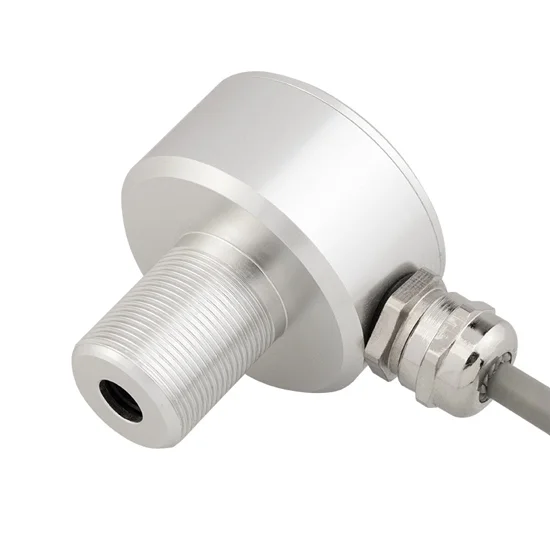
Description
Non-contact infrared temperature sensor with high performance sensor probe, millisecond response speed, can measure temperature continuously, small in size, suitable for narrow working conditions.
Specification
| Model | ATO-BRW600-405 (Click it to see the user manual) |
| Measurement Range | 0 ~ 100℃, 200℃, 300℃, 400℃, 500℃, 600℃, 700℃, 800℃, 900℃, 1000℃, 1200℃ (Optional) |
| Measuring Distance | 10~30 cm |
| Power Supply | 10~30VDC / 5 ~ 30VDC |
| Accuracy | ±2% or ±2℃ |
| Emissivity | 0.95 |
| Signal Output | 4–20 mA or RS485 (Optional) |
| Working Temperature | 50℃ |
| Response Time | 300 ms |
| Response Wavelength | 8~14 μm |
| Maximum Current | < 50 mA |
| Storage Temperature | -40~85℃ |
| Ambient Temperature | 0~60℃ (Better performance at 0 ~ 50℃) |
| Relative Humidity | 10~95% RH (No condensation) |
| Object Distance Ratio | 20:01 |
| Protection Grade | IP65 |
| Dimension | L43mm × φ40mm |
| Shell Material | Aluminium Alloy |
| Weight | 1 kg |
Feature
- Millisecond-Level Response Speed: Equipped with a 32-bit processor, ensuring fast and smooth temperature readings without lag.
- High-Performance Sensor Head: Uses advanced optical lenses to better capture infrared radiation for accurate and reliable measurements.
- Sandblasted Aluminum Housing: Durable anodized aluminum alloy casing resists wear and corrosion, works up to 60°C without peeling.
- Anti-Interference Design: Reinforced EMI shielding allows the sensor to perform reliably even in harsh electromagnetic environments.
- 20:1 Optical Resolution: Allows for precise temperature measurement from a distance, improving safety in high-temperature or hard-to-reach environments.
Dimension (Unit: mm)
Wiring
Principle of measurement
- Anything above absolute zero (-273.15℃) can generate infrared light.
- The infrared temperature receives the infrared dispersion from the object and converts it into a standard signal output through sensors, optical systems and electronic circuits.
- The infrared temperature sensor can calculate the surface temperature of the object by measuring the infrared intensity emitted by the target without touching the target.
- The biggest advantage of non-contact infrared temperature sensors is that users can easily measure targets that are difficult to approach or move.
Optical Resolution: The ratio of the distance from the infrared temperature sensor to the object to the size of the spot being measured (D:S). The larger the ratio, the better the resolution of the instrument and the smaller the measured spot size. The closer the measured object is to black, the higher the measurement accuracy.
Application
Used in power systems, healthcare, manufacturing, metallurgy, petrochemicals, textiles, food, defense, and research.
Tips: What’s the difference between infrared and contact temperature sensors?
Infrared temperature sensors measure thermal radiation emitted by an object without physically touching it. This makes them ideal for moving objects, high-temperature surfaces, or situations where contamination or safety is a concern. In contrast, contact sensors like thermocouples or RTDs require direct surface contact, which may be slower, less sanitary, or impractical in extreme or inaccessible conditions. Infrared sensors are particularly useful in industrial process monitoring, HVAC systems, and food safety where non-invasive, real-time measurement is essential.
Reviews
There are no reviews yet.