
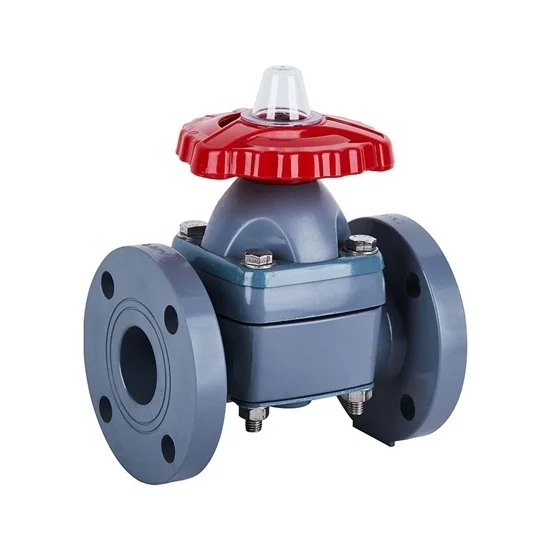
Description
Note: This diaphragm valve cannot be used for drinking water.
The key component of the PVC diaphragm valve is a flexible diaphragm that separates the valve’s body from the flow path. This diaphragm is made of CPVC or UPVC which can withstand corrosive or acidic substances.
Specification
| Model | ATO-FDV-DN25 | |
| Size | 1 inch (DN25) | |
| Structure Type | Flanged Type | |
| Diaphragm Valve Assembly | Parts | Material |
| Diaphragm | PTFE | |
| Film | EPDM | |
| Valve Body | UPVC, CPVC | |
| Valve Plate | UPVC, CPVC, Steel, Stainless Steel | |
| Cover Limit | AS | |
| Stud | Steel, Stainless Steel | |
| Retaining Nut | FRPP | |
| Washer | FRPP | |
| Wheel | Alloy Material | |
| Platen | Steel, Stainless Steel | |
| Double-Headed Stud and Nut | Steel, Stainless Steel | |
| Bonnet | UPVC, CPVC | |
| Yoke Nut | Ht300 Steel | |
| Stem | Steel, Stainless Steel |
Dimension (Unit: mm)
| Size | Valve Body Material | d | D | L | h | n-φ |
| 1 inch (DN25) | UPVC | 86 | 117 | 146 | 19 | 4-φ14 |
| CPVC | 86 | 117 | 147 | 19 | 4-φ14 |
Note: The above dimensions are for reference only, please refer to the actual product.
Detail
Working Pressure
| Size | Working Pressure (MPa) | |||||
| UPVC | CPVC | |||||
| 20~40℃ | 41~60℃ | 61~80℃ | 0~40℃ | 41~60℃ | 61~90℃ | |
| 1/2″ (DN15) | 0.8 | 0.8 | 0.7 | 0.7 | 0.7 | 0.6 |
| 3/4″ (DN20) | 0.8 | 0.8 | 0.7 | 0.7 | 0.7 | 0.6 |
| 1″ (DN25) | 0.8 | 0.8 | 0.7 | 0.7 | 0.7 | 0.6 |
| 1-1/4″ (DN32) | 0.7 | 0.7 | 0.6 | 0.7 | 0.7 | 0.6 |
| 1-1/2″ (DN40) | 0.7 | 0.7 | 0.6 | 0.7 | 0.7 | 0.5 |
| 2″ (DN50) | 0.7 | 0.7 | 0.6 | 0.7 | 0.7 | 0.5 |
| 2-1/2″ (DN65) | 0.7 | 0.7 | 0.6 | 0.7 | 0.7 | 0.5 |
| 3″ (DN80) | 0.7 | 0.7 | 0.6 | 0.7 | 0.7 | 0.5 |
| 4″ (DN100) | 0.7 | 0.7 | 0.6 | 0.7 | 0.6 | 0.5 |
| 5″ (DN125) | 0.5 | 0.5 | 0.4 | 0.5 | 0.5 | 0.4 |
| 6″ (DN150) | 0.5 | 0.5 | 0.4 | 0.5 | 0.4 | 0.3 |
| 8″ (DN200) | 0.3 | 0.3 | 0.2 | 0.5 | 0.3 | 0.25 |
| 10″ (DN250) | 0.3 | 0.3 | 0.2 | 0.3 | 0.3 | 0.2 |
Tips: Flanged diaphragm valve advantages
Flanged diaphragm valves offer several advantages in various industrial applications. Their design features a flexible diaphragm that acts as a barrier between the process fluid and the valve components, providing numerous benefits:
- Exceptional Sealing: Diaphragms ensure a tight and reliable seal, preventing leakage and cross-contamination. This is particularly important in industries where purity and sterility are critical, such as pharmaceuticals or food production.
- Corrosion Resistance: Diaphragm valves can be made from materials that are highly resistant to corrosion, making them suitable for handling aggressive chemicals and corrosive fluids.
- Minimal Maintenance: Their simple construction minimizes the need for maintenance, resulting in reduced downtime and cost savings.
- Precise Flow Control: Diaphragm valves offer excellent throttling capabilities, allowing for precise control over flow rates, making them ideal for applications requiring accurate dosing or control.
- Biocompatibility: In the medical and biotech industries, these valves are suitable for handling sensitive or biocompatible fluids due to their diaphragm materials.
- Reduced Fouling: The smooth, obstruction-free flow path minimizes the risk of fouling and clogging, ensuring consistent performance.
- Versatility: Flanged connections make installation and integration into existing systems straightforward.
Reviews
There are no reviews yet.