
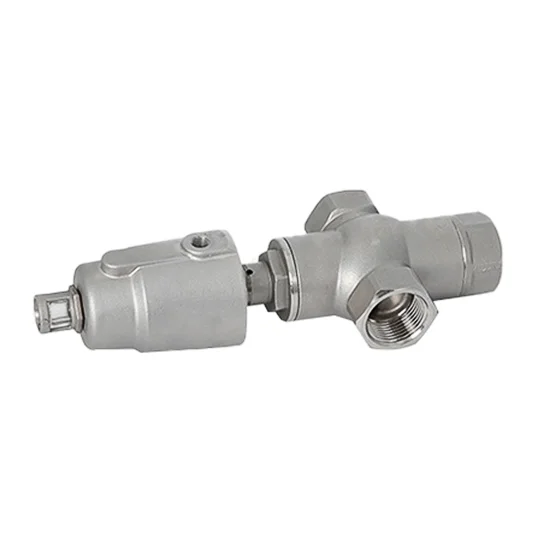
Description
Note: This angle seat valve cannot be used for drinking water.
Featuring a threaded connection for easy installation. Its applicability extends across different mediums, including water, steam, oil, neutral gas or liquid, organic solvents, acid-base solutions, and more.
Specification
| Model | ATO-S3-DN20 |
| Work pressure | Max1.6MPa |
| Control pressure | 0.3-0.8MPa |
| Control medium | Neutral gas or air |
| Body material | CF8M |
| Actuator material | CF8 |
| Material | 304 stainless steel |
| Seal material | PTFE |
| Medium temperature | -10℃~+180 ℃ |
| Ambient temperature | -10℃~+80℃ |
| Control type | Normally closed, Double acting with spring, Doubleacting with compressed air. |
| Connection | Thread |
| Applicable medium | Water, steam, oil, neutral gas or liquid, organic solvent, acid base solution, etc |
| Weight | 3kg |
Function
Pressure Date
Single acting, with strong spring
| Size | Actuator | lnterface | lnner hole (mm) | Flow rate A⟶B | KV (m2/h) A⟶C | Differential pressure range ∆P (MPa) A⟶B / A⟶C | Differential pressure range ∆P (MPa) C⟶A | Control pressure (MPa) |
| DN20 | 50 | 3/4″ | 18 | 5.8 | 6.5 | 0-1.6 | 1.4 | 0.45-0.65 |
Dimension (Unit:mm)
| Size | Actuator | Q | C | R | G | A | K | L | SW | Weight(kg) |
| DN20 | 50 | G1/8 | 60 | 33 | 1/2″ | 230 | 60 | 75 | 32 | 3 |
Tips: What materials are used of pneumatic angle seat valves?
- Stainless Steel: Stainless steel is a common material for pneumatic angle seat valves due to its excellent corrosion resistance. It is ideal for applications where exposure to corrosive substances, high temperatures, or aggressive environments is expected. Stainless steel valves are suitable for industries such as chemical processing, pharmaceuticals, and food and beverage.
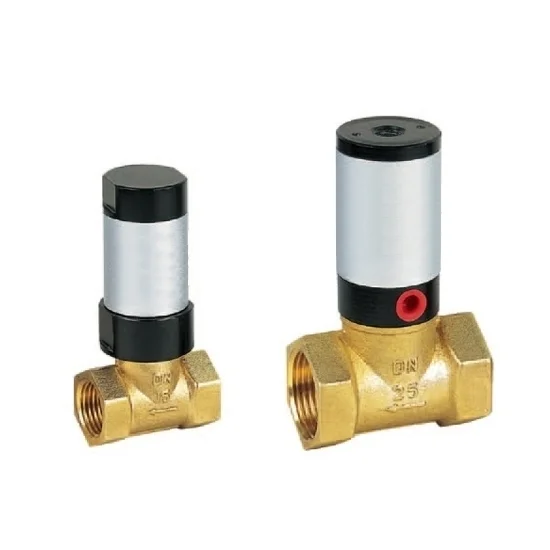
- Brass: Brass is another frequently used material for valve construction. It offers good corrosion resistance, particularly in less aggressive environments. Brass valves are often chosen for applications where cost-effectiveness and moderate corrosion resistance are priorities.
- Alloys: Various corrosion-resistant alloys, such as bronze or nickel alloys, may be employed based on the specific requirements of an application. These alloys enhance the valve’s resistance to corrosion, making them suitable for challenging industrial settings where standard materials might not suffice.
- Seals and Gaskets: The seals and gaskets within the valve are crucial components that come in direct contact with the fluid. Materials like PTFE (polytetrafluoroethylene) or EPDM (ethylene propylene diene monomer) rubber are often used for these components. PTFE provides excellent chemical resistance, while EPDM offers good elasticity and resistance to water and steam.
- Piston/Diaphragm Material: The internal moving parts, such as the piston or diaphragm, are typically made from materials like stainless steel or synthetic materials such as reinforced elastomers. These materials ensure the reliable operation of the pneumatic actuation system and resistance to wear and tear.
Reviews
There are no reviews yet.