
Description
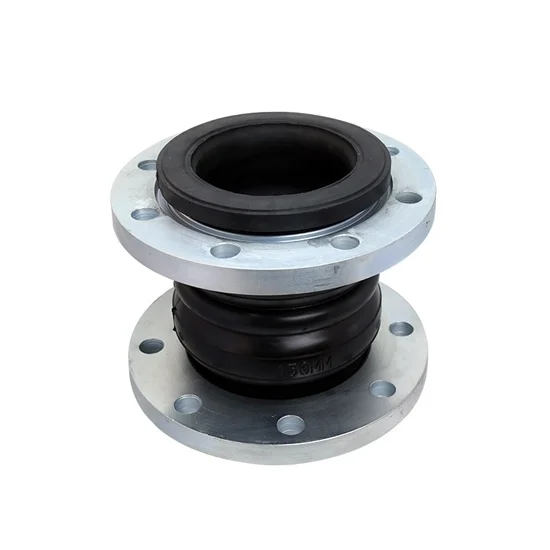
The double sphere rubber expansion joint is a flanged flexible expansion joint, available with 2 inch/3 inch/4 inch/6 inch flange diameter, NR, EPDM, or Neoprene material, carbon steel galvanized flange material, and the pressure and flange material can be customized.
Features
- The double sphere flanged rubber expansion joint is compact in size and lightweight, featuring good elasticity and facilitating easy installation and maintenance. It can reduce the structure-transmitted noise during operation and has a strong shock absorption ability.
- It can produce lateral, axial and angular displacement during installation, and is not restricted by the pipe’s non-concentricity and the flange’s non-parallelism.
- Twin sphere rubber joints can more effectively prevent corrosion in high-temperature, acid-alkali and oil-resistant pipelines, and the medium’s erosion of the rubber joint increases its service life.
- 2 inch/3 inch/4 inch/6 inch flexible rubber joints are available, with good comprehensive performance, and are widely used in various industries and pipeline matching.
Specifications
| Model | ATO-KST-16 |
| Working Pressure (MPa) | PN16, Contact us if you need PN10/PN25. |
| Burst Pressure (MPa) | 3.0 (30) |
| Kpa Vacuum | 86.7 (650) |
| Flange Diameter | DN40-DN300, Contact us if you need a 150LB flange. |
| Flange Material | Carbon Steel Galvanized (Default), Stainless Steel 304/316L or Other Materials (Contact Us) |
| Rubber Material | NR (Default), Nitrile, Neoprene, EPDM, and Other Materials (Contact Us) |
| Applicable Temperature | -20℃~+115℃ (-30℃~+250℃ Under Special Conditions) |
| Applicable Medium | Air, Compressed Air, Water, Sea Water, Oil, Acid, Alkali, etc. |
Dimension (Unit: mm)
| DN | Mpa | L | D | D1 | n | b | Elongation | Compression | Lateral displacement | Deflection displacement | |
| DN40 | 1.6 | 165 | 150 | 110 | 18 | 4 | 16 | 10 | 20 | 20 | 30 |
| DN50 | 1.6 | 165 | 165 | 125 | 18 | 4 | 18 | 10 | 20 | 20 | 30 |
| DN65 | 1.6 | 175 | 185 | 145 | 18 | 4 | 18 | 10 | 20 | 20 | 30 |
| DN80 | 1.6 | 175 | 200 | 160 | 18 | 8 | 20 | 10 | 20 | 20 | 30 |
| DN100 | 1.6 | 225 | 220 | 180 | 18 | 8 | 20 | 15 | 30 | 25 | 30 |
| DN125 | 1.6 | 225 | 250 | 210 | 18 | 8 | 22 | 15 | 30 | 25 | 30 |
| DN150 | 1.6 | 225 | 285 | 240 | 22 | 8 | 22 | 15 | 30 | 25 | 30 |
| DN200 | 1.6 | 325 | 340 | 295 | 22 | 12 | 23 | 20 | 40 | 30 | 30 |
| DN250 | 1.6 | 325 | 405 | 355 | 26 | 12 | 26 | 20 | 40 | 30 | 30 |
| DN300 | 1.6 | 325 | 460 | 410 | 26 | 12 | 28 | 20 | 40 | 30 | 30 |
| No. | Code | Name | Quantity | Material |
| 1 | KST-01 | Reinforcement Ring | 2 | Multi-strand Steel Wire |
| 2 | KST-02 | Flange | 2 | Q235 |
| 3 | KST-03 | Inner Rubber Lining | 1 | Natural Rubber |
| 4 | KST-04 | Outer Rubber Lining | 1 | Natural Rubber |
| 5 | KST-05 | Frame Layer | – | Nylon Cord |
| 6 | KST-06 | Explosion-proof Ring | – | Q235 |
Applications
Tips: What are the materials of rubber expansion joints
Rubber expansion joints can be made from a variety of materials, depending on the application, fluid type, temperature, and pressure conditions. Below is a summary of common rubber materials used in expansion joints, along with their characteristics and typical applications:
- Natural Rubber (NR):
Excellent abrasion resistance and flexibility. Ideal for water and slurry.
Not suitable for oil or chemicals. - Nitrile Rubber (NBR):
Good resistance to oils, fuels, and grease.
Poor weather and ozone resistance. - Neoprene (CR):
Resistant to moderate oil, weather, and ozone.
Used in marine and industrial applications. - EPDM (Ethylene Propylene Diene Monomer):
Excellent for water, steam, acids, and weather.
Not suitable for oil or hydrocarbons.
Reviews
There are no reviews yet.